
The Schrödinger Pen is an Onoto tribute to the life and legacy of Erwin Schrödinger, whose revolutionary work laid the very foundations of modern quantum mechanics and reshaped our understanding of the physical universe. My pen of this series, numbered 2 of a limited edition of only 26, is fitted with a steel nib in an F width, a deliberately understated choice that lets the pen’s conceptual weight rest on the equation rather than the metal.
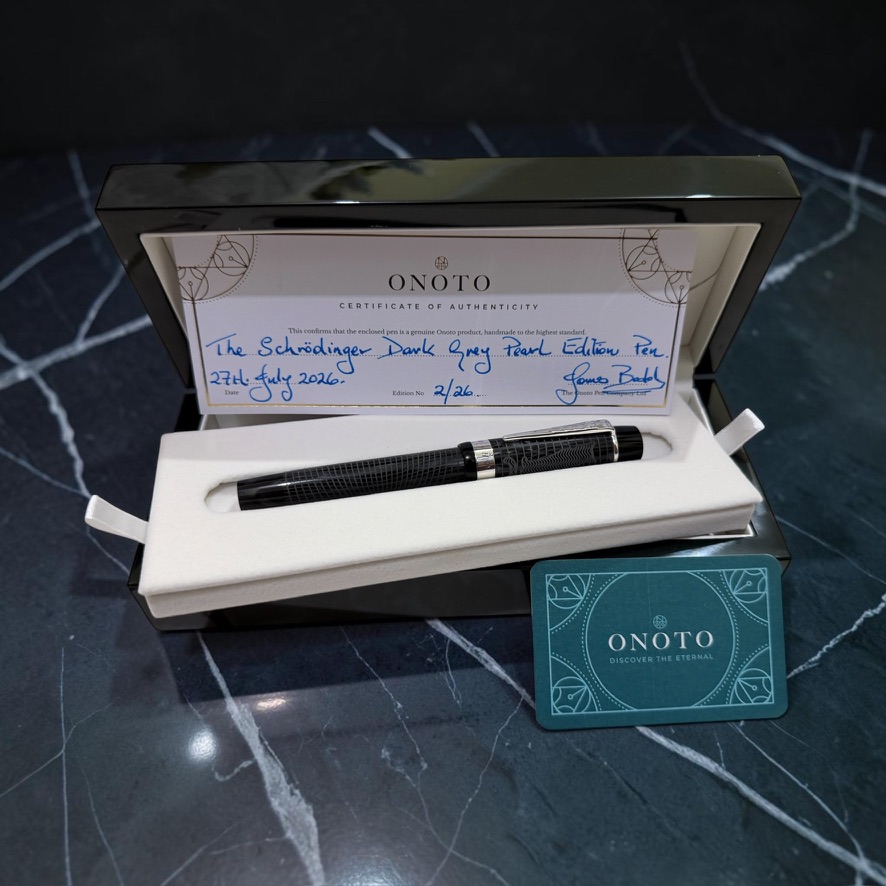
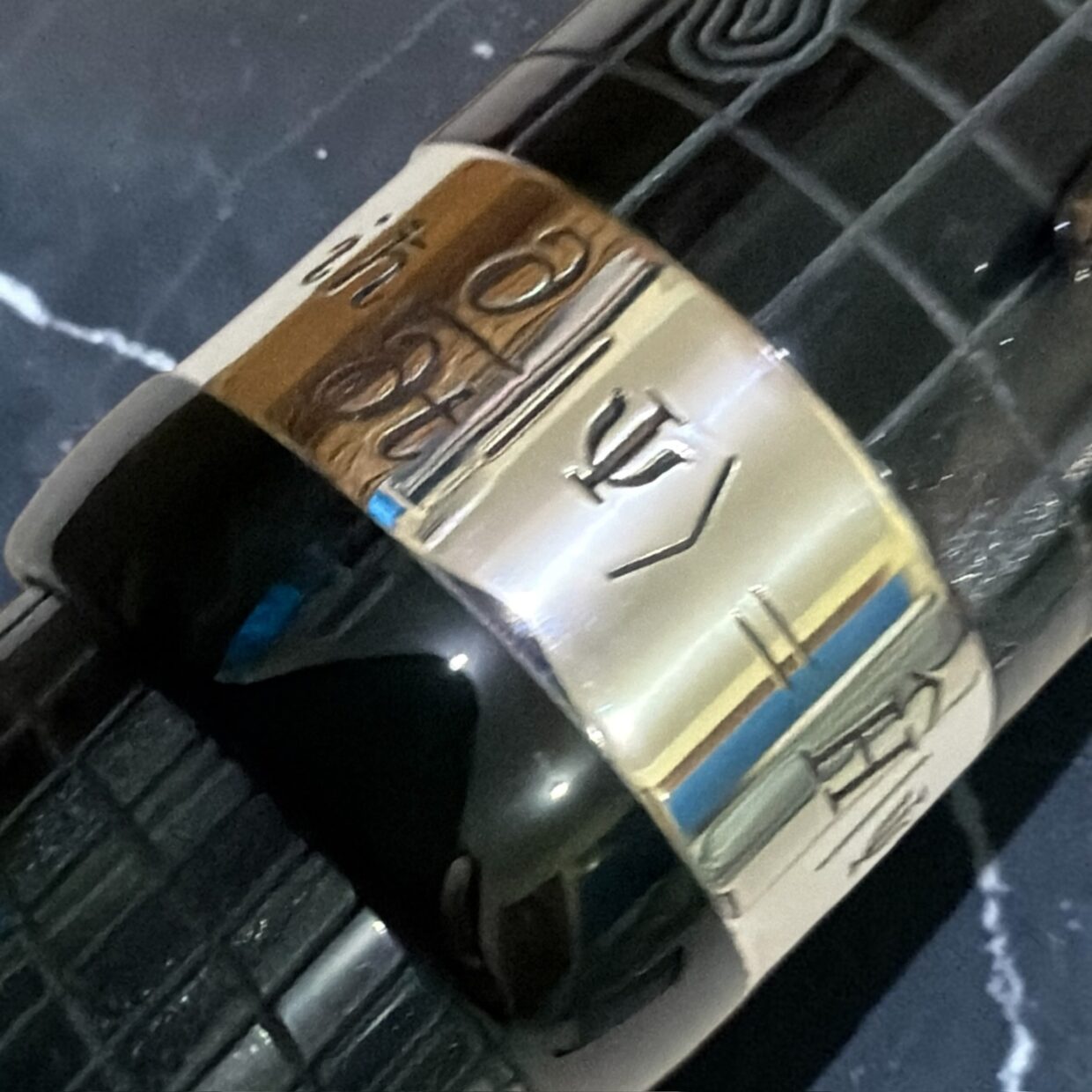
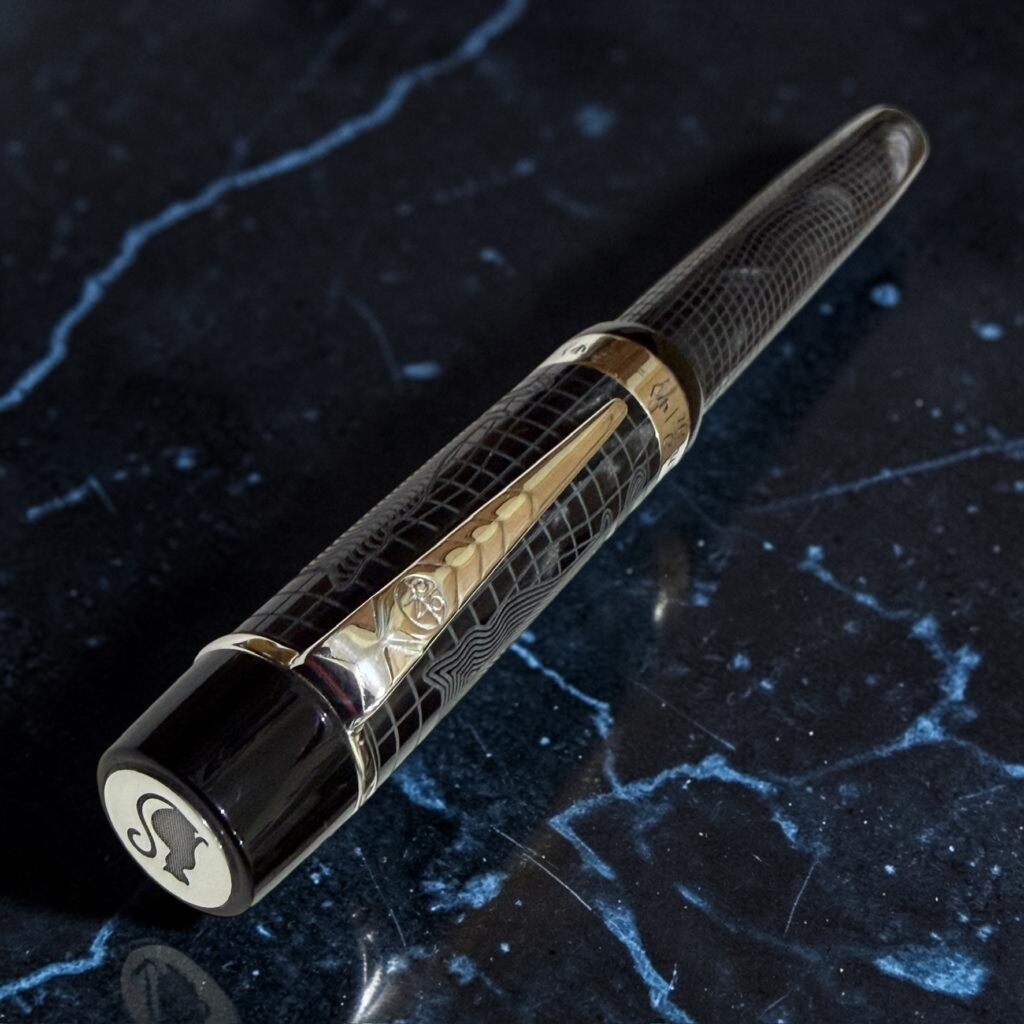
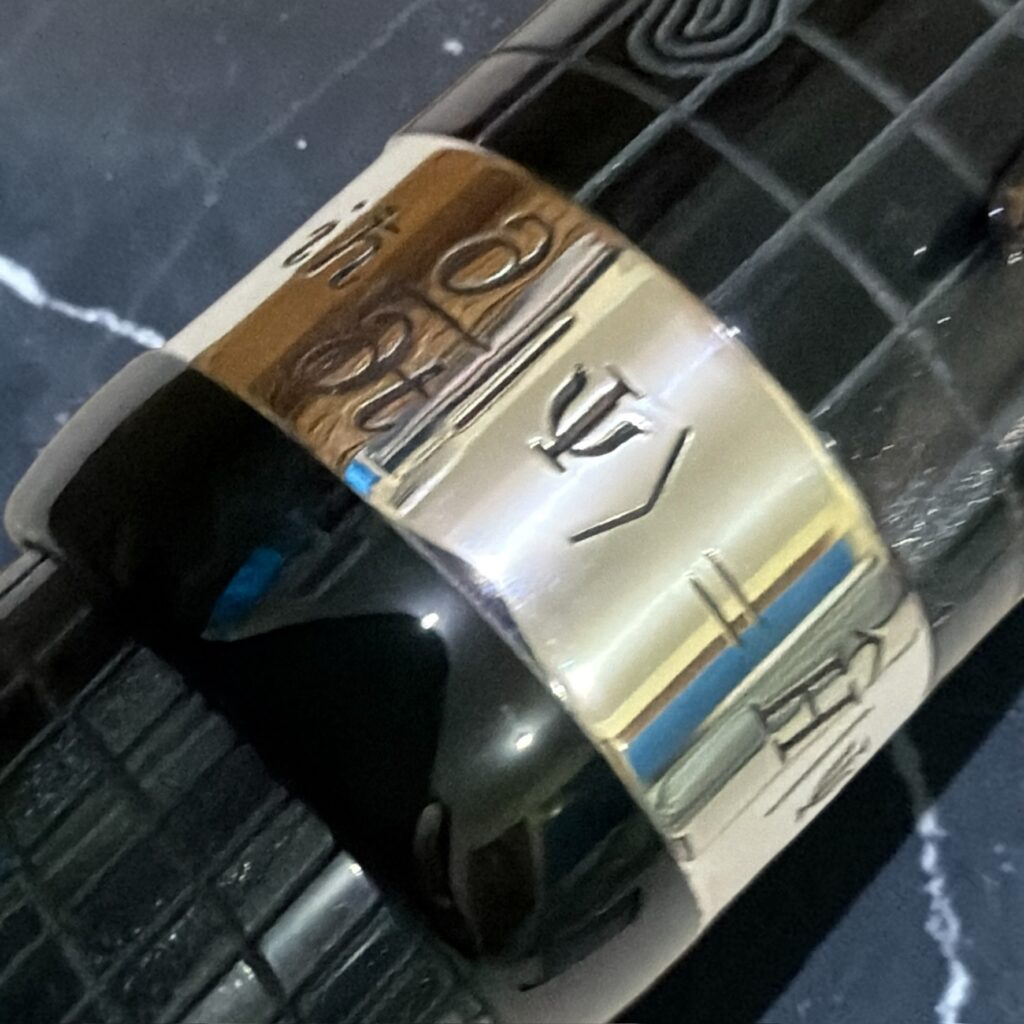
Crafted in a deep, pearlescent dark grey acrylic and finished with sterling silver, the pen conjures something of the vastness of space from which the mysteries of quantum theory first emerged. Across its cap and barrel runs an engraved geometric grid, evoking a distorted space-time lattice, a quiet nod to the mathematical beauty underpinning quantum physics itself. Encircling the cap, engraved into a broad band of sterling silver, sits the Schrödinger equation, arguably the single most influential expression in modern science. On opposite faces of the cap, two engraved cats appear, each rendered with its own distinct internal pattern, standing as complementary perspectives on quantum reality, and as a quiet reminder of the complexity so often hidden beneath deceptively simple forms. The sterling silver cap button, meanwhile, bears Schrödinger’s cat itself, rendered through a fine micro-dot laser technique that builds tonal depth and detail from nothing but carefully arranged points, not unlike the way a wavefunction builds a definite outcome from nothing but probability.
Schrödinger arrived at his equation over the winter of 1925 into 1926, working largely in isolation at a Swiss ski resort, in the company, as legend rather insists, of an unnamed lady friend and a great deal of solitude. He was trying to give physical flesh to Louis de Broglie’s suggestion that particles might also behave as waves. His aims were conservative by the standards of the new quantum theory: he wanted a continuous, classical looking differential equation, something a physicist raised on Newton and Maxwell could recognise, rather than the strange, discontinuous matrix mechanics Heisenberg had produced only months earlier and which Schrödinger rather disliked on aesthetic grounds.
What he produced was a wave equation for a function he called ψ, written in terms of position x and time t, as iℏ ∂ψ(x,t)/∂t = Ĥψ(x,t). It worked beautifully, but it was tied down: ψ meant something specific only once you had chosen to describe the system by position, and switching representation meant starting almost from scratch. It fell to Paul Dirac to show that Schrödinger’s waves and Heisenberg’s matrices were secretly the same theory in different coats. Dirac recast the state as an abstract vector |ψ⟩, unmoored from any representation, and dressed it in bra-ket notation, a small piece of typographical wit splitting the word bracket in two. The equation could then be written once, iℏ ∂/∂t |ψ⟩ = Ĥ|ψ⟩, and translated into whichever language suited the problem at hand.
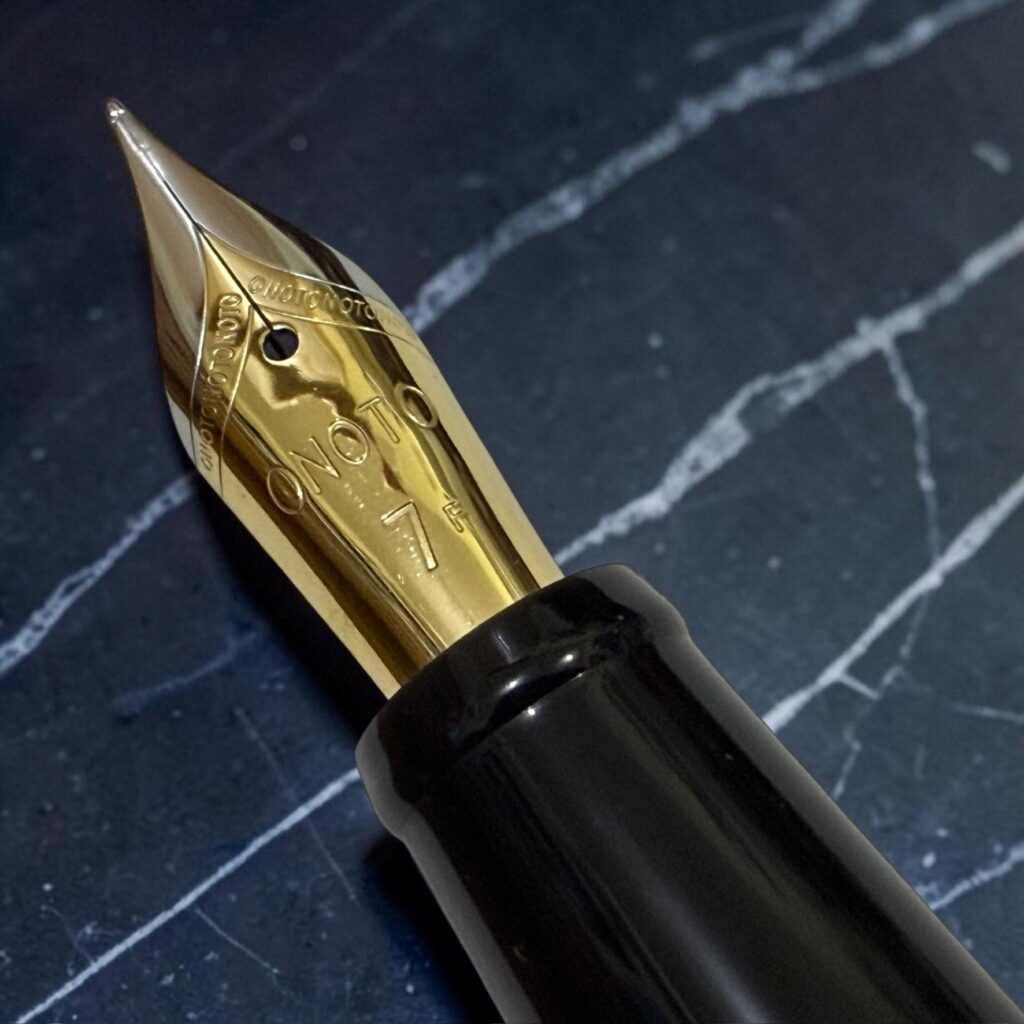
What the equation says, in either dress, is a model of good behaviour: it describes how a quantum state evolves with total determinism, as predictable as a planet tracing its orbit. Give a physicist |ψ⟩ at one moment and the equation returns |ψ⟩ at any later moment with perfect precision. The trouble begins only when someone measures, at which point this clockwork gives way to sudden chance, governed by the squared overlap ⟨φ|ψ⟩. That handover, from deterministic evolution to abrupt probability, is the whole of the interpretive puzzle, and the equation offers no opinion on why it happens.
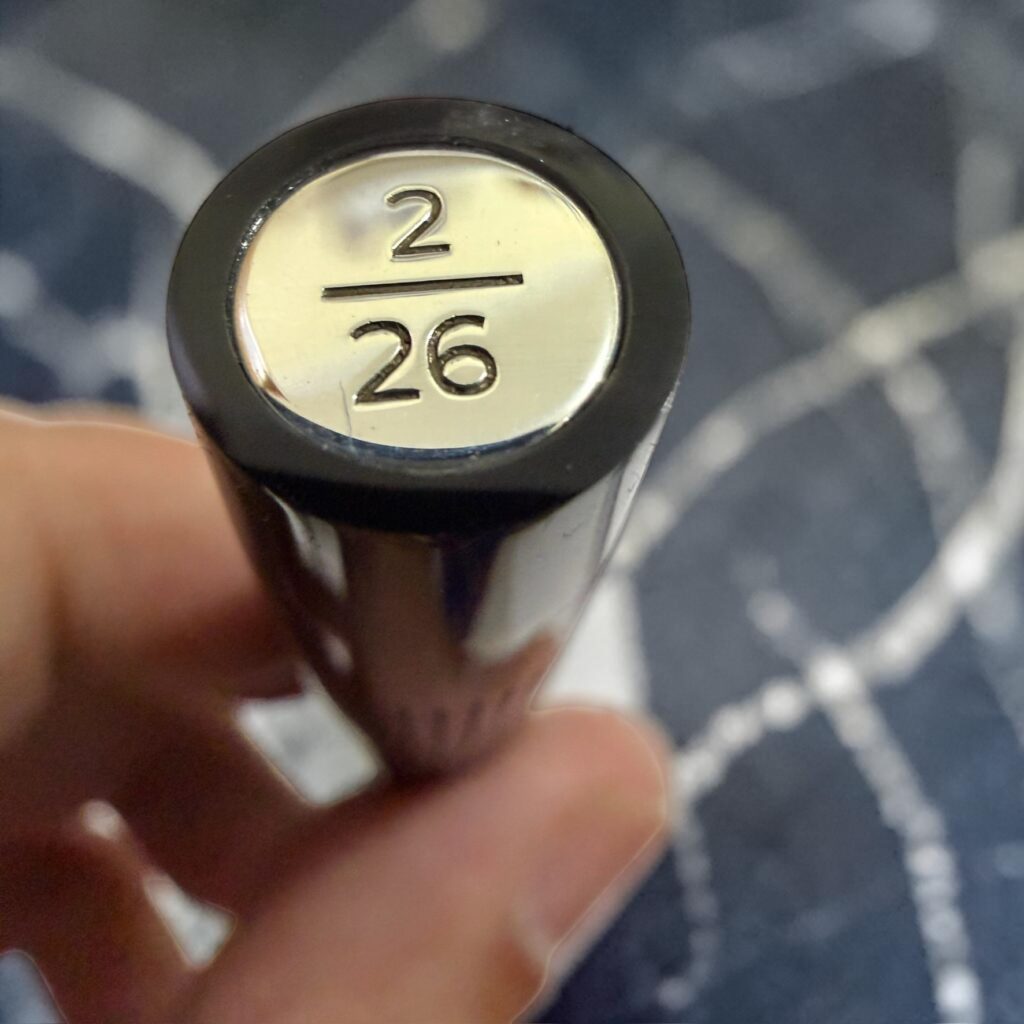
Copenhagen’s interpretation simply declares that measurement causes |ψ⟩ to collapse onto one outcome, and discourages further questions. Everett’s many worlds view refuses the shrug entirely, insisting nothing collapses, every outcome occurring in its own branch. Pilot wave theory proposes particles had definite positions all along, quietly guided by ψ, so the randomness was only ever human ignorance in disguise. All three predict identical results, which is rather the point, and the scandal, of the whole affair.
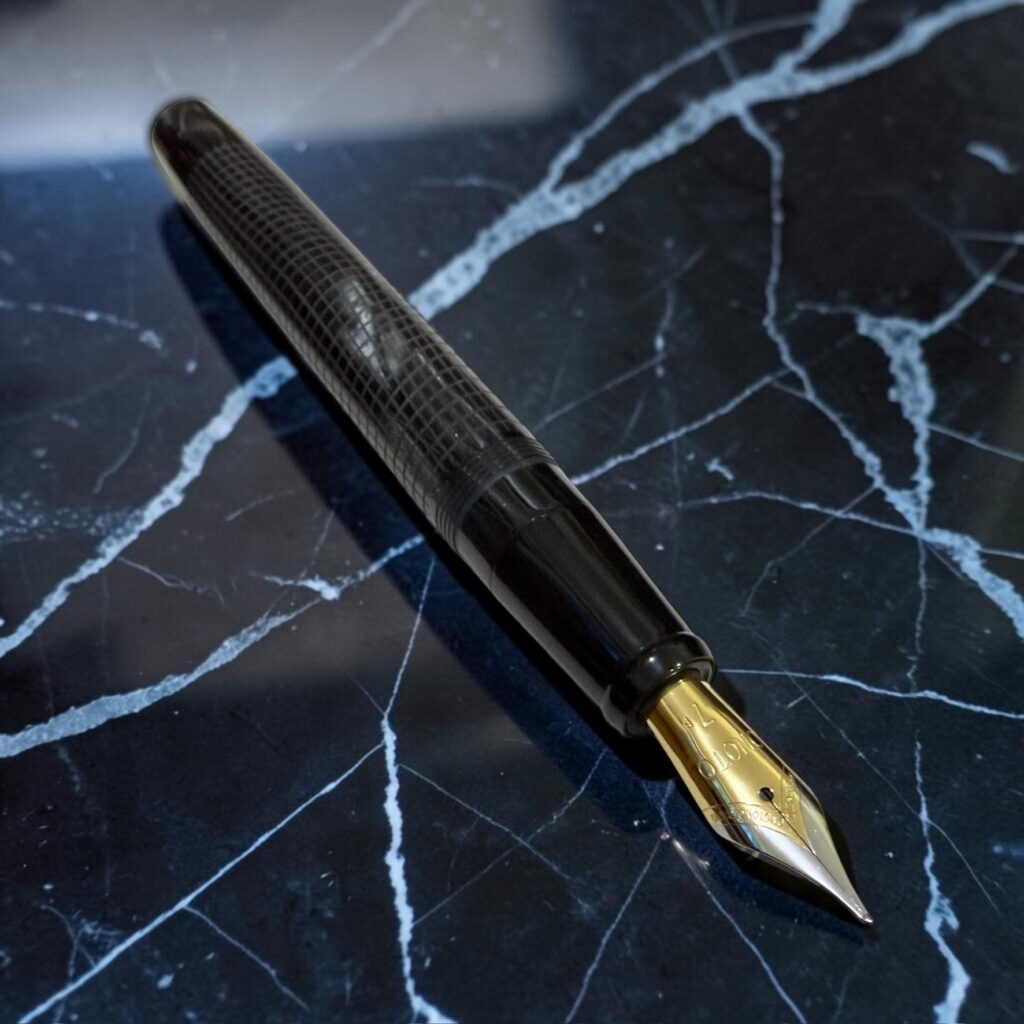
Look closely at the barrel and you find two cats hiding in the grid itself, woven so subtly into the crossed lines that they exist only as long as you know where to look, vanishing the moment your attention drifts, resolved into something definite only once, on the cap button, where the laser has finally made up its mind. And there is something in the material itself that carries the argument further: turn the pen in the light and the pearlescent grey shifts and ripples like nothing quite solid, closer to the passage of light itself, the way starlight bends and scatters, the way a photon or an electron behaves as wave until something forces it to behave as particle, caught forever between the curvature of space-time and the plain fact of a line on paper.